 Brown&Co

California almond sector sees light at the end of the tunnel
Wed 22 Apr 2026
NCREIF data indicates the Almond Capital Index has decreased by a huge 41.72 percent since the first quarter of 2020 and is down 49.10 percent since its peak in 2016. Three year annualised returns for Almonds show income of 1.27%, capital of -13.13% and total annualised returns being -12.00%. Has the sector turned a corner?
Market rebalancing
California had a strong production year in 2025, producing 1.36 million tons of kernels, compared with 1.23 million tons in 2024. This made 2025 the second-highest production year on record, behind 2020, which remains the highest at 1.41 million tons.
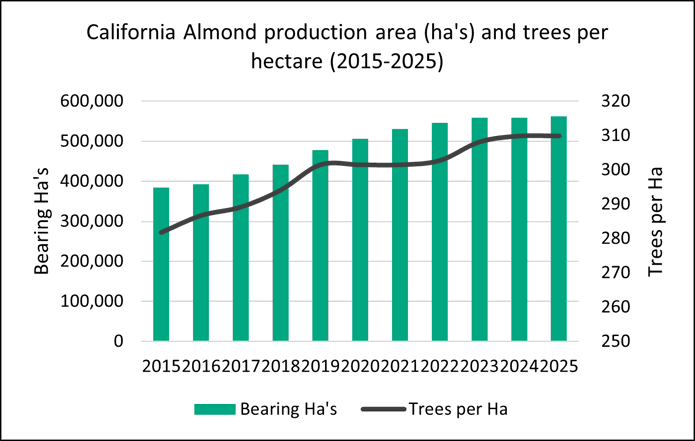

California produced an average of 4,364 nuts per tree in 2025, up from 4,072 in 2024. The best-performing varieties in 2025 were Butte, Nonpareil, and Monterrey, which recorded 4,820, 4,526, and 4,156 nuts per tree, respectively. The top-performing counties were Merced, Tulare, and San Joaquin.
However, the broad trend has been towards lower overall areas as the removal rates in recent years have been substantial. In 2024, it was estimated some 26,700 ha were removed with approximately 20,000 ha the year before.
Prices on the up
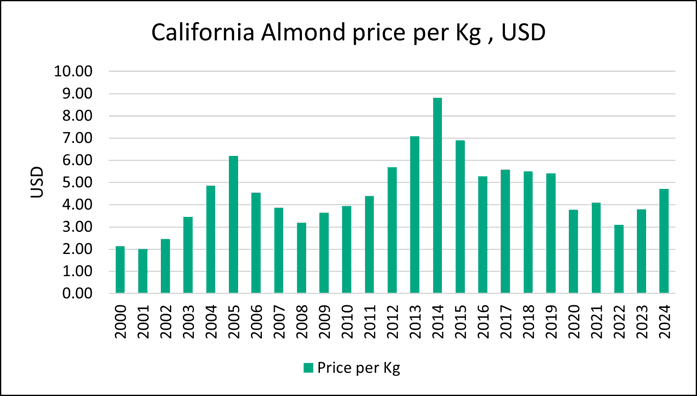
Prices dropped in 2022 to USD 3.09/kg and have since recovered to an extent. In 2024, the price reached USD 4.72/kg, up from USD 3.79/kg in 2023, but still below the 10-year average of USD 4.81/kg for the period 2015–2024. Although prices have improved, the industry has suffered very significant losses in the meantime.
Margins have been firmly in negative territory and it is estimated operating costs have increased between 27 and 40% over the last five years with further pressure from water availability constraints. One of the most significant increases has been in pollination costs, which have risen by 15% alone.
Exports strong
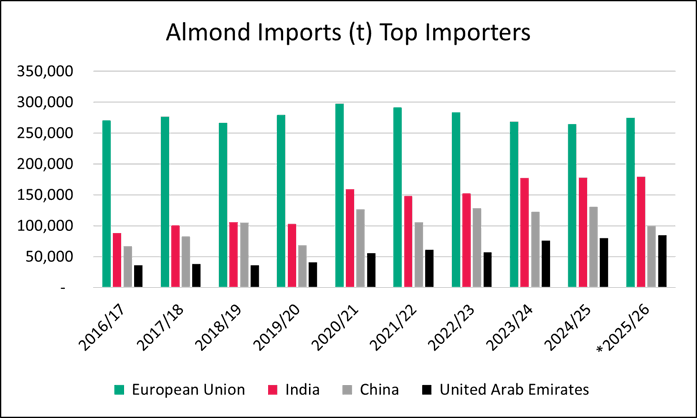
Global almond consumption has increased over the past decade, and the 2025/26 season is expected to be record-breaking, with consumption estimated at 1.65 million tons (shelled). The United States, particularly California, remains the world’s largest producer and supplies the majority of this market.
Global demand is being driven mainly by India, China, the UAE and developing nations. While the United States and the European Union remain the largest consumers, demand growth in these regions has been comparatively slower.
Summary
Demand is expected to continue growing as developing nations strengthen their purchasing power. In addition, almonds and other nuts continue to be seen as healthy, convenient snack options.
The sector believes that after losing 41% of capital value since 2020 – there may be light at the end of the tunnel. A real issue relates to water rights and a substantial part of the losses incurred are likely to have come from those assets with insufficient water rights. As the State of California implements the Sustainable Groundwater Management Act – it seems highly likely that substantial additional areas will be removed (to include redevelopment) – further limiting bearing acres and supporting a global demand and supply re-balancing.
Europe
The EU remains the largest consumer of almonds, but local production is insufficient to satisfy demand. At the same time, there is increasing pressure to expand local supply, particularly given trade disruptions and price uncertainty. As a result, the EU continues to rely heavily on the US to meet its almond demand, with smaller quantities also imported from Australia. However, the quantity imported by the EU has gradually decreased over the last four years, from approximately 300,000 tons in 2021/22 to around 277,000 tons in 2024/25.
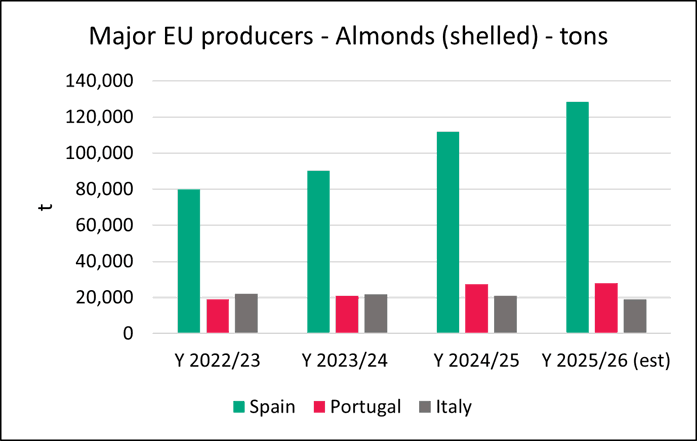
This decline partly reflects a gradual increase in European production, with Spain remaining by far the largest producer in Europe.
Spain pricing
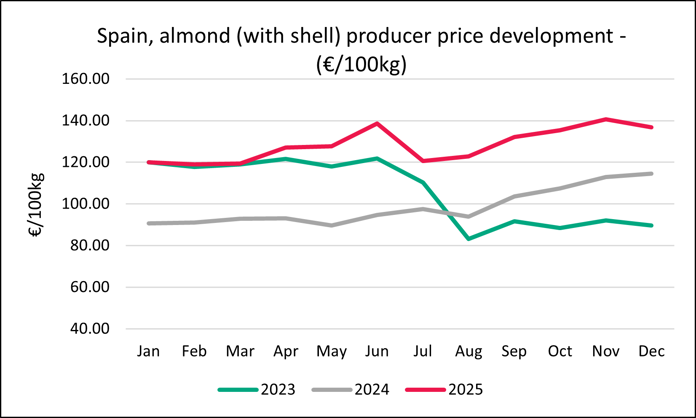
Prices in Spain recovered from the global decline recorded in July 2023, finishing 2025 at approximately €1.36/ kg, compared with €1.14 in 2024 and €0.89 in 2023. Conditions in 2024 and 2025 were characterised by lower climatic stress, reduced cheaper imports from the US, and an expansion of irrigated land in Spain, all of which contributed to higher pricing in both the Spanish and wider European market.
Spain production area and irrigation
In Spain, irrigation is a key driver of almond crop area expansion.
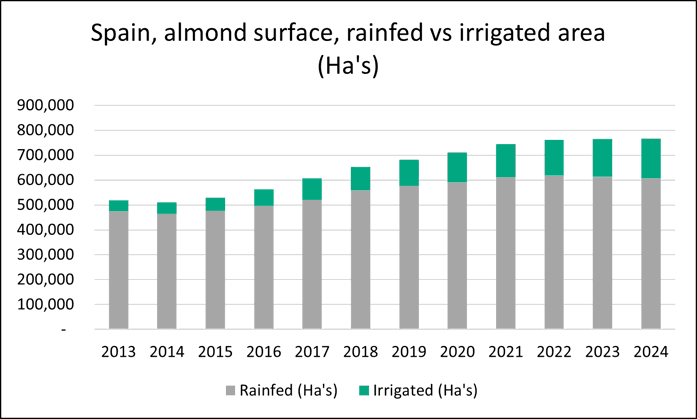
In 2024, Spain’s irrigated almond area was 159,000 hectares, out of a total of 766,000 hectares under almond cultivation, equivalent to around 20% of the total area. By comparison, in 2014, the irrigated almond area stood at 46,000 hectares out of 511,000 hectares, representing approximately 9%.
Irrigated land not only brings confidence and stability to the European market, but also enables more specialised, high-technology production systems, such as super high-density almond plantations.
In terms of pricing, the varieties Marcona and Largueta perform particularly well in Spain’s largest almond-growing region, Andalucía, averaging €5.33/kg and €4.92/kg respectively.
Summary
Consumption in Europe continues to be on a rising trajectory and EU almond markets are, in some studies projected to double by 2035. Key drivers are: health positioning, transition towards plant based ingredients, dietary trends (gluten free) and traditional uses in confectionary (marzipan, nougat).
European supply remains import dependent, but is increasing as Spain in particular expands areas, and in particular continues the structural shift away from extensive traditional rain fed orchards to modern irrigated intensive systems. The share of irrigated orchards has moved from c. 5% in 2005 to c. 26% currently.
European almond production can represent an attractive investment opportunity, supported by positive global demand and growing pressure to increase food security and self-sufficiency. European production is increasing but is insufficient to keep pace with growing demand. Companies that can address water scarcity, adopt new technologies and modern cultivars and can improve water efficiency are best placed to compete in the global almond market.
Sources
U.S. Department of Agriculture, National Agricultural Statistics Service. (2025, July 10). 2025 California almond objective measurement report 202507almondOM.pdf
U.S. Department of Agriculture, Foreign Agricultural Service. (2025, February). Tree nuts: World markets and trade. https://esmis.nal.usda.gov/sites/default/release-files/tm70mv16z/6h442p825/2b88s996b/TreeNuts-Feb-2025.pdf
MAPA Ministerio de Agricultura Pesca y Alimentacion (2025) Data base
https://www.mapa.gob.es/es/estadistica/temas/estadistica-digital/powerbi-precios-percibidos-pagados
Mapa Ministerio de Agricultura Pesca y Alimentacion (2025) Superficies y producciones anuales de cultivos
Keep updated
Keep up-to-date with our latest news and updates. Sign up below and we'll add you to our mailing list.